Organic or Paid: The Question I Get Asked Most, and Why It's the Wrong One
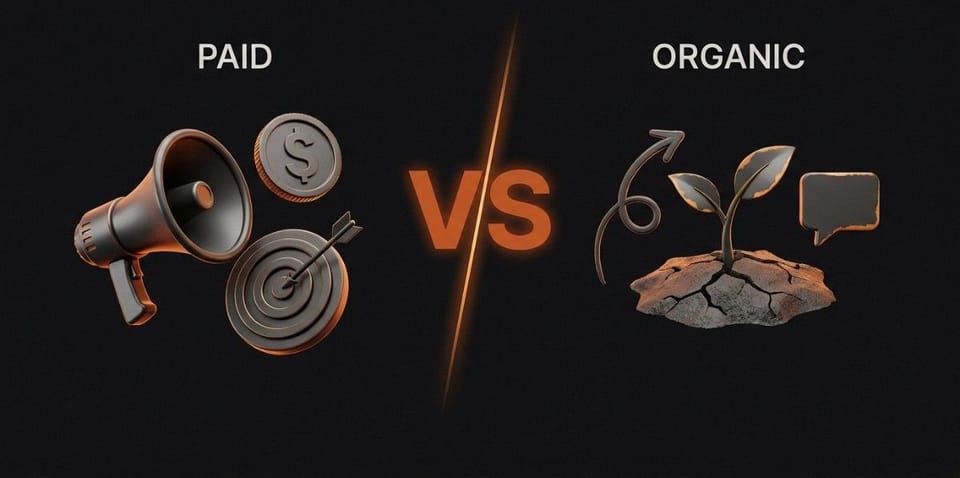
Every founder who reaches out to me eventually asks some version of the same question. Should we go organic or should we turn on paid.
I used to answer it directly. Now I don't, because the question itself is backwards.
The real question is: do you already have a message worth scaling?
Paid doesn't build that message. It just moves whatever message you already have, faster, to more people, for money. If the message is weak, paid makes it fail faster and more expensively. That's the whole trick of it.
Paid feels like progress because the dashboard moves. CTR goes up, impressions go up, someone on the team feels productive. But a good CTR on a mediocre idea just means you found the least-bad version of a bad answer.
I built Flamme to 200K+ users and 50M+ organic views without spending a dollar on acquisition. Not because paid is evil. Because we didn't have a message worth paying to scale yet, and paid would have hidden that from us instead of showing it to us.
Organic is brutal and it is honest. That's the entire point of it.
There's no participation trophy in organic. If the hook doesn't stop the scroll, you fail immediately, in public, for free. If the video gets views but nobody saves it or shares it, you also fail, just more slowly, and that failure teaches you something different. Either way you learn what's actually wrong with the story you're telling, because the algorithm and the audience have zero incentive to be polite about it.
Paid can tell you whether a message wins on a spreadsheet. Only organic tells you whether a message deserves to win at all.
Your customers write better copy than your marketing team does.
This one took me a while to actually believe, not just repeat. At Agniverse we run 50+ TikTok accounts as live infrastructure, and the highest-performing content almost never came from someone sitting in a room trying to sound clever. It came from watching how real people already talk about the problem.
An edtech founder thinks they're selling "faster English learning." The person actually paying is buying confidence to build a life abroad, make friends, date, stop feeling like an outsider. Same product. Completely different reason to care.
You don't get that insight from a Meta ad account. You get it from comments, from Reddit, from sitting inside the actual language people use when nobody's trying to sell them anything.
Paid should amplify a winner, not replace the search for one.
This is where I see teams burn the most money for the least reason. They find something that resonates organically and instead of asking "why did this work" they just throw budget at it, assuming the winner will hold forever. It won't. Every winner gets tired.
Organic's job never stops being to go find the next one, even after you've scaled the current one. Paid amplifies. Organic discovers. Confuse the two and you end up perpetually optimizing yesterday's idea while your competitor finds tomorrow's.
The actual decision isn't organic vs paid. It's: what's your current bottleneck.
Once you stop treating the two channels as rivals, the decision gets simple. Ask two questions.
Do you already know, with evidence, what reliably creates demand for this product? And is your current best channel starting to fatigue?
If you don't know what creates demand yet, no amount of budget fixes that. You need organic, you need it running as a real testing system.
If you do know what creates demand and it's starting to plateau, paid is exactly the right tool to squeeze more out of it while organic keeps hunting for the next input. Neither channel is a strategy on its own. The bottleneck tells you which one you actually need right now.
Most companies think creators are the scarce resource. They're not. Judgment is.
We built Handler internally at Agniverse for exactly this reason, because our TikTok Farming System generates volume most teams can't process by hand. Every hypothesis, every hook, every piece of creative feedback in one place, so a decision engine, not a reporting dashboard.
Reporting tells you what happened after the fact. What you actually need is something that tells you what to try next. A hypothesis in, a decision out. That's the difference between a team that generates 100 posts and learns nothing, and a team that generates 100 posts and knows exactly which idea to double down on by Friday.
The first instinct most founders have is to hire creators. I think that's backwards. Creators are where the strategy gets executed, not where it gets defined. Define the bet first. Then go find who can bring it to life.
If there's one thing I want people to actually remember from this, it's the timing mistake, not the channel mistake.
Organic growth is a game of patience and surgical precision. The first attempt at a new idea usually doesn't work. The second attempt often doesn't either. What looks like luck from the outside is almost always someone who stayed in the game long enough to notice what was actually resonating, and had the discipline to keep pushing on that one signal instead of scattering across ten new ones. The breakout moment is rarely a new idea.
It's the same idea, said slightly better, one more time, right before most people would have quit and called it a dead channel.
Keep digging until something moves. When it moves, resist the urge to declare victory and go find the next thing. Reproduce it first. Understand why it worked. Then keep digging again.
That compounding loop, dig → learn → amplify → dig again, is the whole system.
Dig deeper into the debate with this informed post by my partner-in-crime and partner-in-life, Lauriane Meunier Nayal: Paid vs organic was never really the question.
-An